Insecure Direct Object References (IDOR) is a security vulnerability that occurs when an application allows users to directly access or modify objects (such as files, database records, or URLs) based on user-supplied input, without sufficient access controls. This means that if a user changes a parameter value (like an ID) in a URL or API request, they might be able to access or manipulate data...
Installs into .claude/skills of the current project.
Are you the author of Payloads Idor?
Add the live security badge to your README. It updates with every re-scan.
[](https://www.skillsdirectory.com/skills/smartworldarafath-payloads-idor)
---
name: payloads-idor
description: "Insecure Direct Object References (IDOR) is a security vulnerability that occurs when an application allows users to directly access or modify objects (such as files, database records, or URLs) based on user-supplied input, without sufficient access controls. This means that if a user changes a parameter value (like an ID) in a URL or API request, they might be able to access or manipulate data..."
---
# IDOR Payloads
> **Source:** [PayloadsAllTheThings/Insecure Direct Object References](https://github.com/swisskyrepo/payloadsallthethings/tree/master/Insecure%20Direct%20Object%20References)
> **Category:** `payloads-web` | **Skill ID:** `payloads-idor`
## Overview
IDOR/BOLA payloads for direct object reference attacks and authorization bypass techniques.
This skill integrates the full **PayloadsAllTheThings** (PATT) payload library for the **IDOR Payloads** domain into the REA_Skill framework. Use it during authorized penetration testing, bug bounty research, security audits, and CTF challenges.
## Workflow
### 1. Recon & Identification
- Identify the target technology stack and injection points
- Enumerate endpoints, parameters, and input vectors
- Determine applicable payload categories from the reference below
### 2. Payload Selection
- Browse the PATT payload library for the attack class
- Select encoding-appropriate payloads for the target environment
- Consider WAF bypass variants and obfuscation techniques
### 3. Exploitation (Authorized Only)
- Test payloads in order: passive → active → escalation
- Document every payload tested and its response
- Capture PoC evidence (screenshots, HTTP logs, curl output)
### 4. Verification & Reporting
- Confirm the vulnerability with a clean minimal PoC
- Map findings to CVE/CWE where applicable
- Report with remediation recommendations and code fixes
---
## Full PATT Reference
# Insecure Direct Object References
> Insecure Direct Object References (IDOR) is a security vulnerability that occurs when an application allows users to directly access or modify objects (such as files, database records, or URLs) based on user-supplied input, without sufficient access controls. This means that if a user changes a parameter value (like an ID) in a URL or API request, they might be able to access or manipulate data that they aren’t authorized to see or modify.
## Summary
* [Tools](#tools)
* [Methodology](#methodology)
* [Numeric Value Parameter](#numeric-value-parameter)
* [Common Identifiers Parameter](#common-identifiers-parameter)
* [Weak Pseudo Random Number Generator](#weak-pseudo-random-number-generator)
* [Hashed Parameter](#hashed-parameter)
* [Wildcard Parameter](#wildcard-parameter)
* [IDOR Tips](#idor-tips)
* [Labs](#labs)
* [References](#references)
## Tools
* [PortSwigger/BApp Store > Authz](https://portswigger.net/bappstore/4316cc18ac5f434884b2089831c7d19e)
* [PortSwigger/BApp Store > AuthMatrix](https://portswigger.net/bappstore/30d8ee9f40c041b0bfec67441aad158e)
* [PortSwigger/BApp Store > Autorize](https://portswigger.net/bappstore/f9bbac8c4acf4aefa4d7dc92a991af2f)
## Methodology
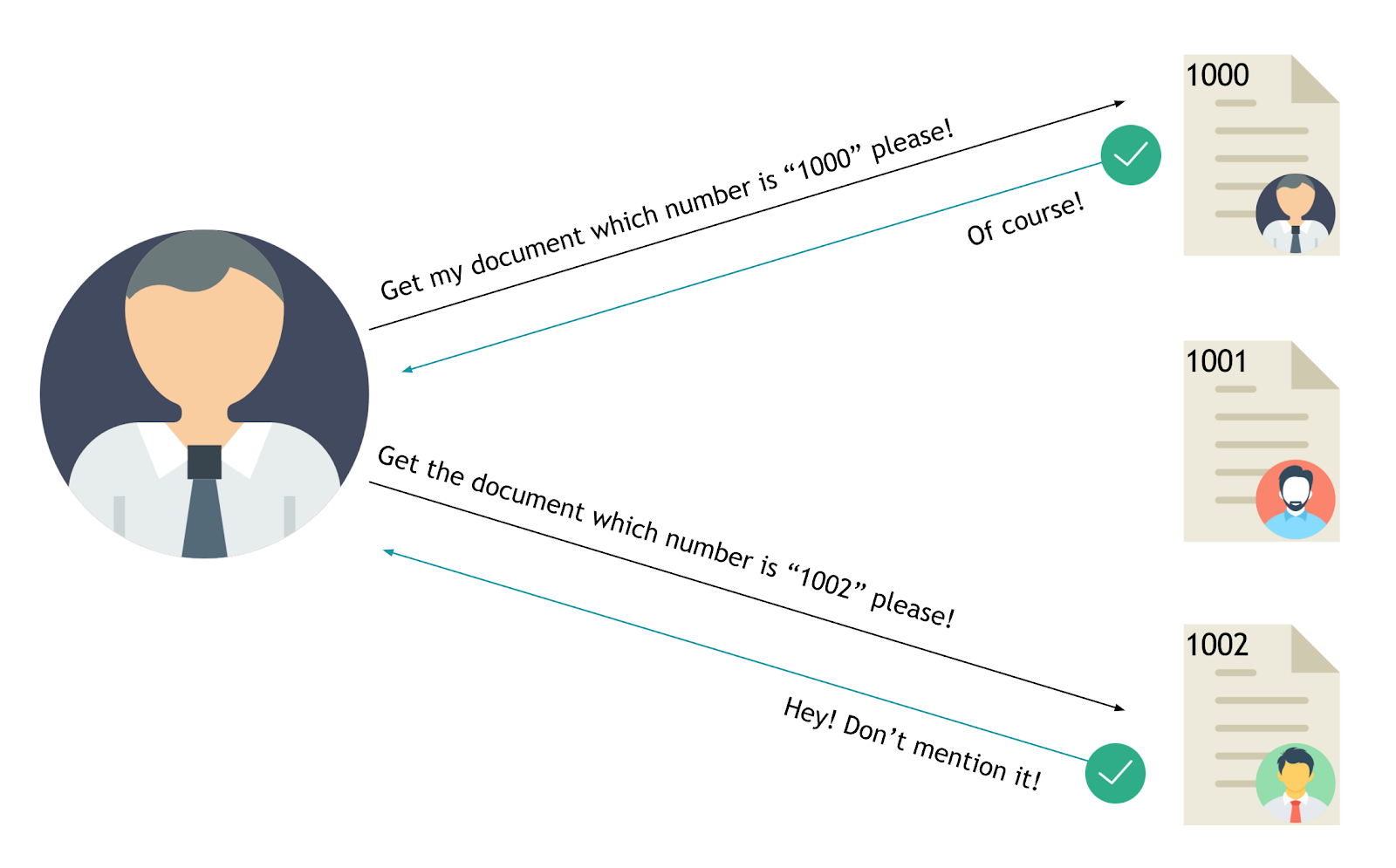
IDOR stands for Insecure Direct Object Reference. It's a type of security vulnerability that arises when an application provides direct access to objects based on user-supplied input. As a result, attackers can bypass authorization and access resources in the system directly, potentially leading to unauthorized information disclosure, modification, or deletion.
**Example of IDOR**:
Imagine a web application that allows users to view their profile by clicking a link `https://example.com/profile?user_id=123`:
```php
<?php
$user_id = $_GET['user_id'];
$user_info = get_user_info($user_id);
...
```
Here, `user_id=123` is a direct reference to a specific user's profile. If the application doesn't properly check that the logged-in user has the right to view the profile associated with `user_id=123`, an attacker could simply change the `user_id` parameter to view other users' profiles:
```ps1
https://example.com/profile?user_id=124
```
### Numeric Value Parameter
Increment and decrement these values to access sensitive information.
* Decimal value: `287789`, `287790`, `287791`, ...
* Hexadecimal: `0x4642d`, `0x4642e`, `0x4642f`, ...
* Unix epoch timestamp: `1695574808`, `1695575098`, ...
**Examples**:
* [HackerOne - IDOR to view User Order Information - meals](https://hackerone.com/reports/287789)
* [HackerOne - Delete messages via IDOR - naaash](https://hackerone.com/reports/697412)
### Common Identifiers Parameter
Some identifiers can be guessed like names and emails, they might grant you access to customer data.
* Name: `john`, `doe`, `john.doe`, ...
* Email: `john.doe@mail.com`
* Base64 encoded value: `am9obi5kb2VAbWFpbC5jb20=`
**Examples**:
* [HackerOne - Insecure Direct Object Reference (IDOR) - Delete Campaigns - datph4m](https://hackerone.com/reports/1969141)
### Weak Pseudo Random Number Generator
* UUID/GUID v1 can be predicted if you know the time they were created: `95f6e264-bb00-11ec-8833-00155d01ef00`
* MongoDB Object Ids are generated in a predictable manner: `5ae9b90a2c144b9def01ec37`
* a 4-byte value representing the seconds since the Unix epoch
* a 3-byte machine identifier
* a 2-byte process id
* a 3-byte counter, starting with a random value
**Examples**:
* [HackerOne - IDOR allowing to read another user's token on the Social Media Ads service - a_d_a_m](https://hackerone.com/reports/1464168)
* [IDOR through MongoDB Object IDs Prediction](https://techkranti.com/idor-through-mongodb-object-ids-prediction/)
### Hashed Parameter
Sometimes we see websites using hashed values to generate a random user id or token, like `sha1(username)`, `md5(email)`, ...
* MD5: `098f6bcd4621d373cade4e832627b4f6`
* SHA1: `a94a8fe5ccb19ba61c4c0873d391e987982fbbd3`
* SHA2: `9f86d081884c7d659a2feaa0c55ad015a3bf4f1b2b0b822cd15d6c15b0f00a08`
**Examples**:
* [IDOR with Predictable HMAC Generation - DiceCTF 2022 - CryptoCat](https://youtu.be/Og5_5tEg6M0)
### Wildcard Parameter
Send a wildcard (`*`, `%`, `.`, `_`) instead of an ID, some backend might respond with the data of all the users.
* `GET /api/users/* HTTP/1.1`
* `GET /api/users/% HTTP/1.1`
* `GET /api/users/_ HTTP/1.1`
* `GET /api/users/. HTTP/1.1`
### IDOR Tips
* Change the HTTP request: `POST → PUT`
* Change the content type: `XML → JSON`
* Transform numerical values to arrays: `{"id":19} → {"id":[19]}`
* Use Parameter Pollution: `user_id=hacker_id&user_id=victim_id`
## Labs
* [PortSwigger - Insecure Direct Object References](https://portswigger.net/web-security/access-control/lab-insecure-direct-object-references)
## References
* [From Christmas present in the blockchain to massive bug bounty - Jesse Lakerveld - March 21, 2018](http://web.archive.org/web/20180401130129/https://www.vicompany.nl/magazine/from-christmas-present-in-the-blockchain-to-massive-bug-bounty)
* [How-To: Find IDOR (Insecure Direct Object Reference) Vulnerabilities for large bounty rewards - Sam Houton - November 9, 2017](https://web.archive.org/web/20260221194813/https://www.bugcrowd.com/blog/how-to-find-idor-insecure-direct-object-reference-vulnerabilities-for-large-bounty-rewards/)
* [Hunting Insecure Direct Object Reference Vulnerabilities for Fun and Profit (PART-1) - Mohammed Abdul Raheem - February 2, 2018](https://web.archive.org/web/20190509043727/https://codeburst.io/hunting-insecure-direct-object-reference-vulnerabilities-for-fun-and-profit-part-1-f338c6a52782)
* [IDOR - how to predict an identifier? Bug bounty case study - Bug Bounty Reports Explained - September 21, 2023](https://web.archive.org/web/20231027235449/https://youtu.be/wx5TwS0Dres)
* [Insecure Direct Object Reference Prevention Cheat Sheet - OWASP - July 31, 2023](https://web.archive.org/web/20140316052400/https://www.owasp.org/index.php/Insecure_Direct_Object_Reference_Prevention_Cheat_Sheet)
* [Insecure direct object references (IDOR) - PortSwigger - December 25, 2019](https://web.archive.org/web/20260301072233/https://portswigger.net/web-security/access-control/idor)
* [Testing for IDORs - PortSwigger - October 29, 2024](https://web.archive.org/web/20230604162333/https://portswigger.net/burp/documentation/desktop/testing-workflow/access-controls/testing-for-idors)
* [Testing for Insecure Direct Object References (OTG-AUTHZ-004) - OWASP - August 8, 2014](https://web.archive.org/web/20170712205114/https://www.owasp.org/index.php/Testing_for_Insecure_Direct_Object_References_(OTG-AUTHZ-004))
* [The Rise of IDOR - HackerOne - April 2, 2021](https://web.archive.org/web/20211004153030/https://www.hackerone.com/company-news/rise-idor)
* [Web to App Phone Notification IDOR to view Everyone's Airbnb Messages - Brett Buerhaus - March 31, 2017](https://web.archive.org/web/20170408053950/http://buer.haus:80/2017/03/31/airbnb-web-to-app-phone-notification-idor-to-view-everyones-airbnb-messages)
---
## REA MCP Integration
```javascript
// REA MCP — Automated payload injection via REA tools
// Use analyze_function, procedure_pseudo_code, or observe_native_calls
// to identify injection sinks, then apply payloads from this skill.
```
## Legal Notice
> ⚠️ **Authorized Use Only.** All payloads in this skill are for security research, penetration testing with written permission, CTF competitions, and defensive study. Unauthorized use against systems you do not own or have explicit permission to test is illegal.

